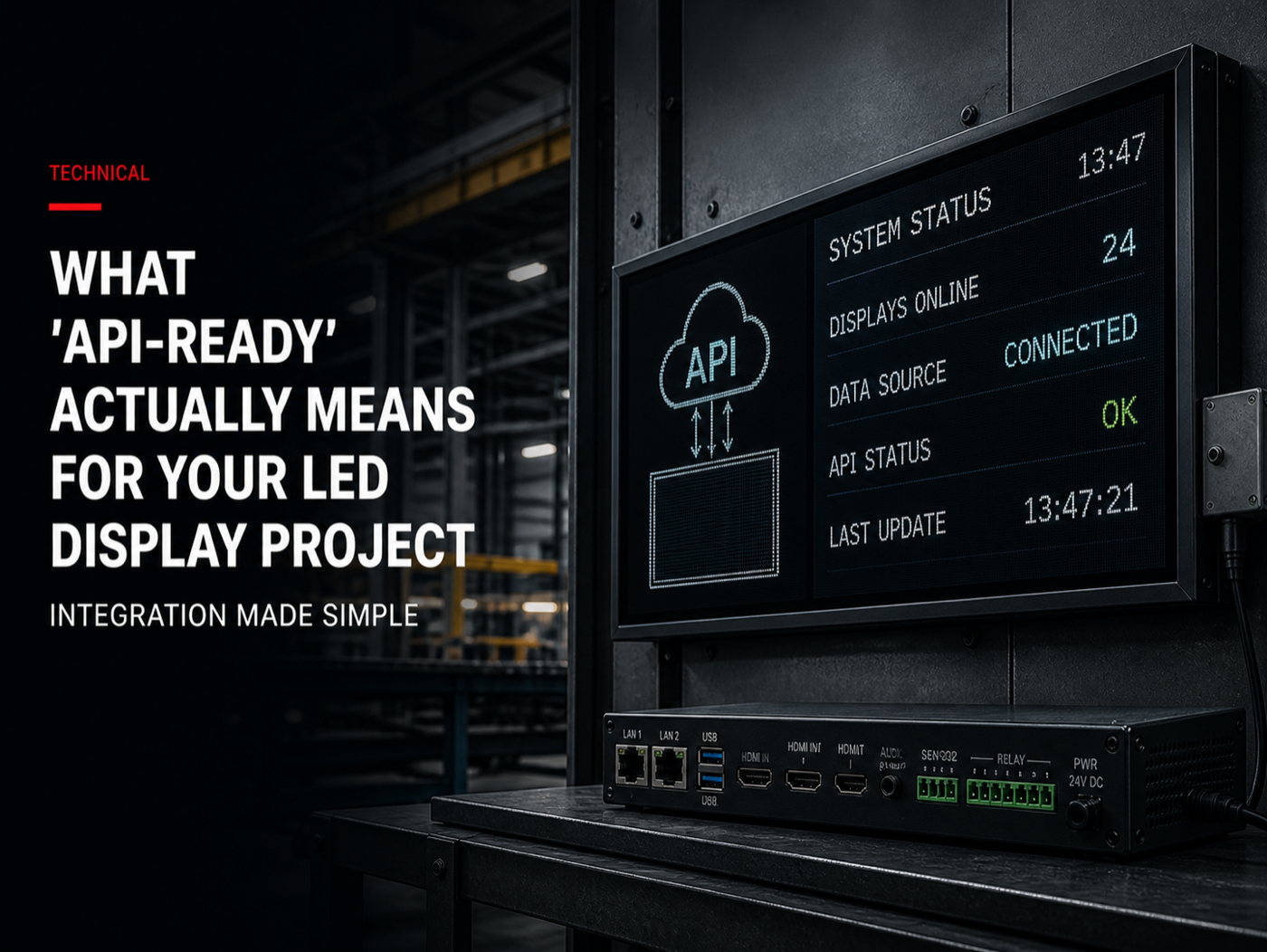
When you ask a display supplier whether their product has an API, you will almost always get the answer 'yes'. But the word API covers an enormous range of capabilities — from a fully-documented REST interface that any developer can use in an afternoon, to a proprietary serial protocol that requires a paid middleware license and a week of specialist time. Understanding the difference before you commit to hardware can save a project from a painful integration phase.
A REST API — the type Ampron uses across all product lines — means the display is controlled via standard HTTP requests. The same protocol your web browser uses. There is no special driver software, no vendor-supplied SDK, and no locked binary format. Your software sends a web request to an address, and the display updates. Your developers use tools they already know. Your integration team does not need to become display hardware specialists.

The practical impact shows up in integration time. At the Port of Kunda, Waybiller connected its weighbridge platform to Ampron displays over the documented HTTP API. At bus stops in Estonia, a transit software provider's platform feeds our BS-series boards the same way: each display polls the REST API directly, with no middleware in between. In both cases the integration is plain HTTP that the software team can read, test and change on their own schedule.
Contrast that with the alternative: a display with a proprietary control protocol. The supplier provides documentation — if it exists at all — in a PDF last updated four years ago. Your team needs to reverse-engineer packet structures, handle binary framing, and write a translation layer that then needs to be maintained every time either system changes. This is not hypothetical. It is the norm with much of the display hardware that predates the REST era.

When evaluating supplier API claims, ask four specific questions. First: is the API documented publicly, or does it require signing an NDA? Public documentation signals confidence in the product and an expectation that developers will use it without hand-holding. Second: what authentication model does it use? Token-based HTTP authentication is standard and straightforward. If the answer involves custom session management or binary handshakes, factor in complexity. Third: does the API support push and pull? Push means your system sends updates to the display; pull means the display polls your system for data. Both have valid use cases. A good API supports both. Fourth: what happens when the network drops? The display should have configurable fallback content and reconnection behaviour — documented behaviour, not undocumented firmware.
Ampron's REST API, documented at ampron.eu/api, uses standard bearer-token authentication and supports both push and pull data models. Full documentation is public. Every product in the Ampron range — DR Series outdoor LED, DS Series compact LED, LCD EN 50121 railway displays — uses an identical API surface, which means integration code written for one display type works on all others. When your integration is already running in one facility, adding a second site is a configuration change, not a new project.
The buying decision around API capability is easy to defer — it feels like a technical detail that can be sorted out after the hardware order. In practice, it determines how much of your integration budget goes to your team's billable time versus emergency consulting from the display vendor. API quality is not a specification footnote. It is a core selection criterion.