Transit
Real-Time Passenger Information Displays for Estonian Public Transport
Client
Ridango AS — Estonian transit-software company behind the real-time public transport information platform used by Tartu and Pärnumaa. Ridango holds the stop-display service contracts with Tartu city and the Pärnumaa public transport centre, and its platform supplies the live departure data shown at the stop.
Ridango is Ampron's direct commercial partner on this programme. The end users are city and county passengers; the contracting relationship is between Ampron and Ridango.
The task
A passenger information display at a bus stop has to survive Estonian outdoor conditions — sun, rain, snow, temperature swings — while showing live departure data from the platform behind it. The hardware also has to fit the platform's architecture: pull data straight from Ridango's API, be remotely manageable, and be repairable without replacing the fleet.
Ampron's solution
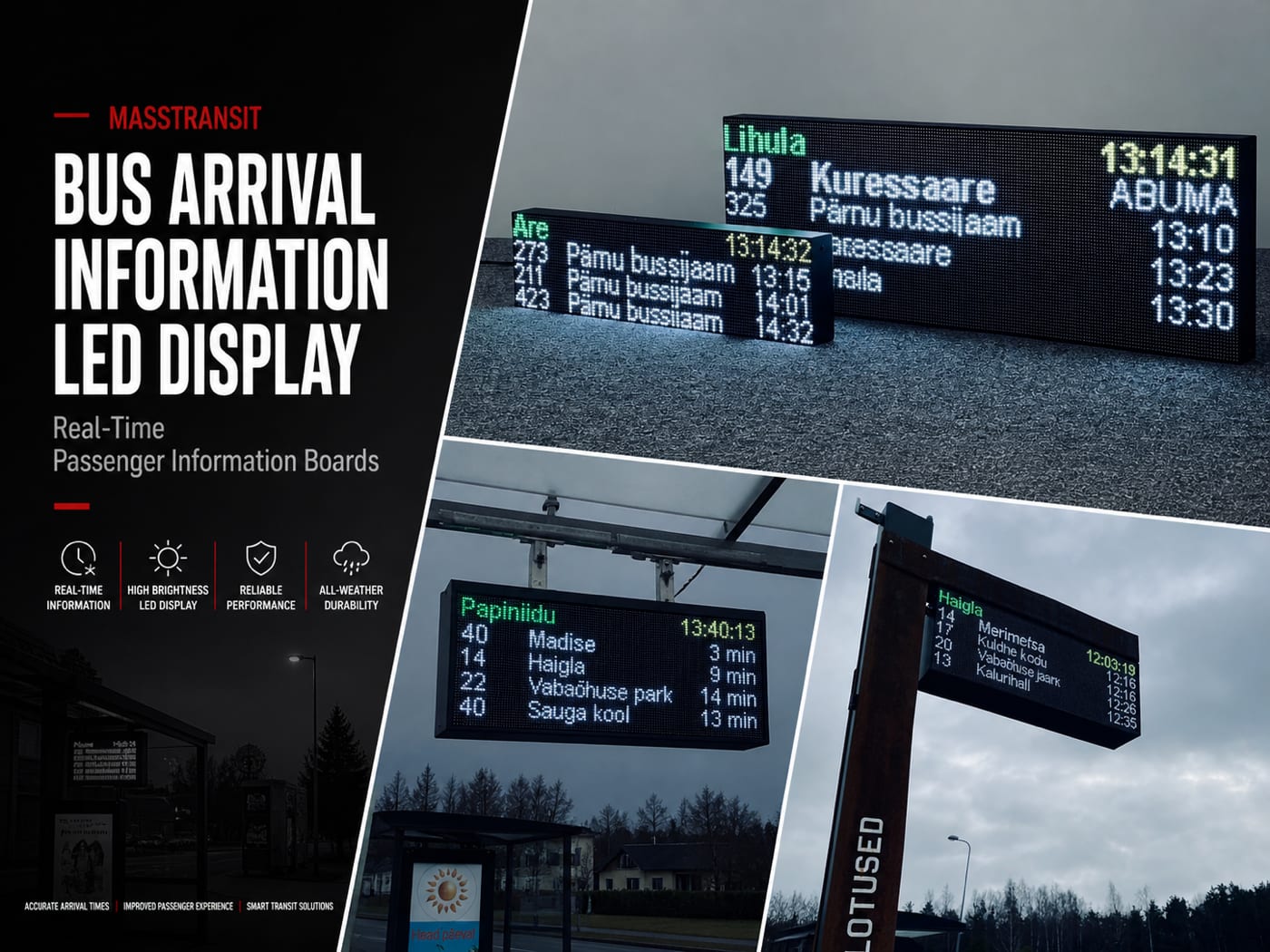
Since 2020, Ampron has built 96 BS-series full-matrix LED bus-stop displays for Ridango's network.
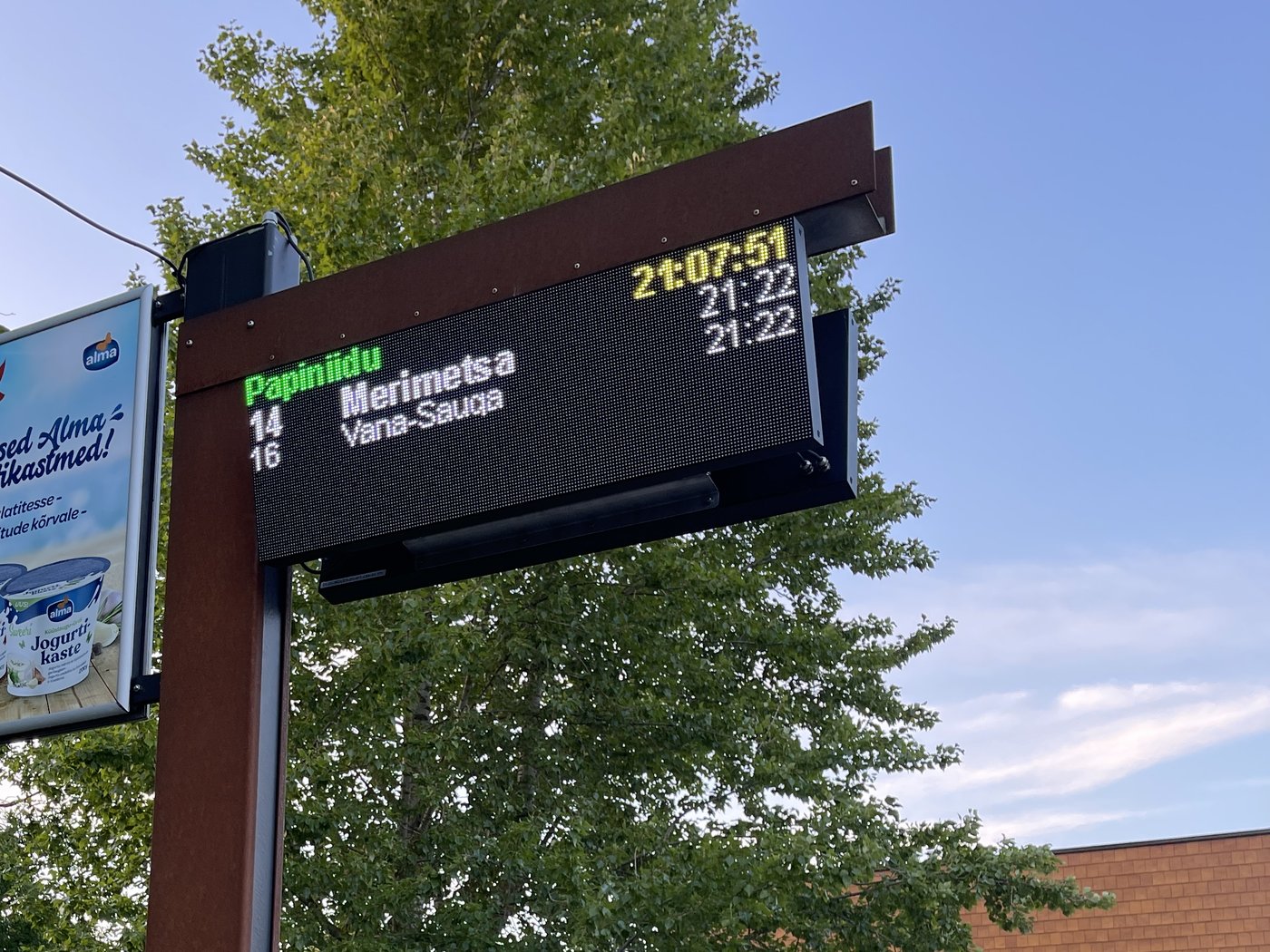
- Tartu — 54 double-sided displays plus 3 spares, delivered under the 2024 supply contract with Ridango and installed on the city's existing poles in August 2024. The fleet mixes two-, four- and six-row boards (23 × BS-640x160, 31 × BS-640x320) to match each stop, and every unit has a push-button audio announcement of upcoming departures in Estonian.
- Pärnu city and county — 37 displays, built in two generations: 7 units between 2020 and 2022, starting with Are and Lihula in October 2020, and 30 units in 2024–25 covering stops from Pärnu bus station to Kilingi-Nõmme and Tõstamaa. One stop, Pärnu Haigla, runs off-grid on solar power with battery storage.
- 2 more in Tartu (Päevakivi) run on Ridango's network, supplied through a third party.
Each display polls Ridango's real-time API directly from its own controller over a mobile router. There is no Ampron server in the data path. If data stops arriving, the board says so ("Uuendame andmeid") rather than showing stale departures.
Partnership model
- Ridango owns the passenger information platform, the relationships with the cities and transport authorities, and the service delivered to passengers.
- Ampron designs and builds the displays, configures them for Ridango's API, and supports the hardware.
Ridango brings the software platform and the operator relationships. Ampron brings the display hardware and the engineering behind it.
Warranty and support
The Tartu fleet is covered by warranty and remote management until 30 June 2029. Repairs are done at the Ampron factory in Estonia, and software fixes and updates are pushed to the displays over the network. On-site maintenance is carried out by Ridango's own field contractor, whom Ampron has trained on the hardware.
Built for Estonian outdoor conditions
The BS-series enclosures are sheet steel. Ampron tested them in-house to IP65 and IK08. They run from the stop's mains supply at a 60 W average. Brightness follows a light sensor, so the board stays readable in summer sun without glaring at night.
Why this matters
The stop-level display is the last metre between a transit platform and the passenger. If it fails or shows stale data, the passenger blames the whole service. Ridango and Ampron cover that last metre with Estonian-built software and Estonian-built hardware, and the displays have been running across Pärnumaa since 2020 and across Tartu since 2024.
Installation photos
From the field
Hardware