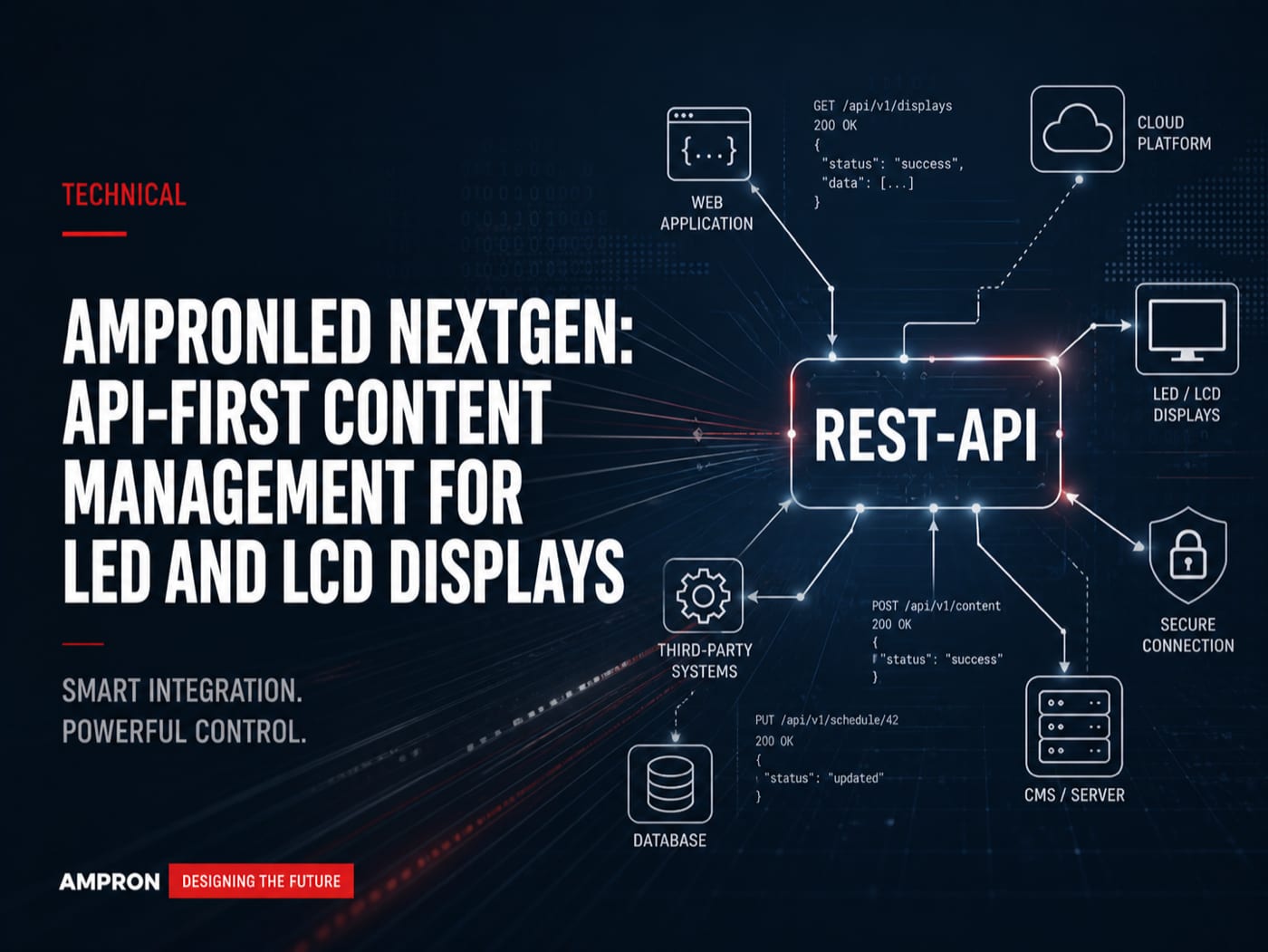
Headless content management means content is pulled via API into any digital endpoint, deeply integrated with data sources rather than managed through a standalone CMS. AmpronLED NextGen is built on this architecture — it controls, manages and monitors both LED and LCD displays through HTTP requests, with no separate server component between the controlling system and the display hardware.
In the previous generation of AmpronLED, all HTTP requests went through a central server. With NextGen, requests go directly to each display's own API endpoint. This simplifies the network architecture and removes a failure point from the integration path.
Two communication modes are available: polling (the display fetches updated content from a configured endpoint on each cycle) and push (content is sent to the display when an update occurs). Polling is suited to mobile applications where continuous connectivity cannot be guaranteed; push is more efficient for static installations on a reliable network.
A screenshot API allows any display to return a current image of what it is showing. This integrates into monitoring dashboards, giving operators a visual confirmation of display state alongside uptime and health metrics.
Partial display refresh is supported — individual zones can be updated without refreshing the entire screen. This matters for multi-zone displays showing different data streams simultaneously. Firmware and configuration updates are delivered over the air.
The design approach is developer-first: the back-end API is documented and open, integration is handled by the integrator's own team using standard HTTP, and a front-end user interface is optional — built on top of the API if the customer needs it.