Moving aircraft de-icing operations from terminal gates to a remote pad addresses three operational problems simultaneously: environmental compliance, ground safety, and on-time performance. De/anti-icing fluid is hazardous to drainage systems and must be collected and processed; at gate positions, it flows directly to the apron without control. Gate de-icing also makes the parking area slippery during a busy turnaround — a hazard to ground crews sharing a confined space with jet bridges, catering vehicles and fuel trucks.
The on-time performance impact of gate de-icing is significant. Treatment typically starts after doors close and the jet bridge retracts, immediately before pushback. A standard two-step de-icing procedure at the gate guarantees a delay. Holdover time — the period during which de/anti-icing fluid remains effective — begins when the final step completes. If the taxi route to the runway is long, holdover may expire before takeoff clearance, requiring a second treatment or a departure delay.
A remote de-icing pad, positioned near the departure runway, eliminates these problems. Fluid containment is engineered into the pad design; aircraft are treated at the point where holdover time works in their favour; and gate utilisation improves because stands turn around without waiting for the de-icing sequence. Communication between the de-icing operator and flight crew is the critical link at the remote pad — without visual signage, it relies entirely on radio, which introduces latency and ambiguity at a phase of operations where precision matters.
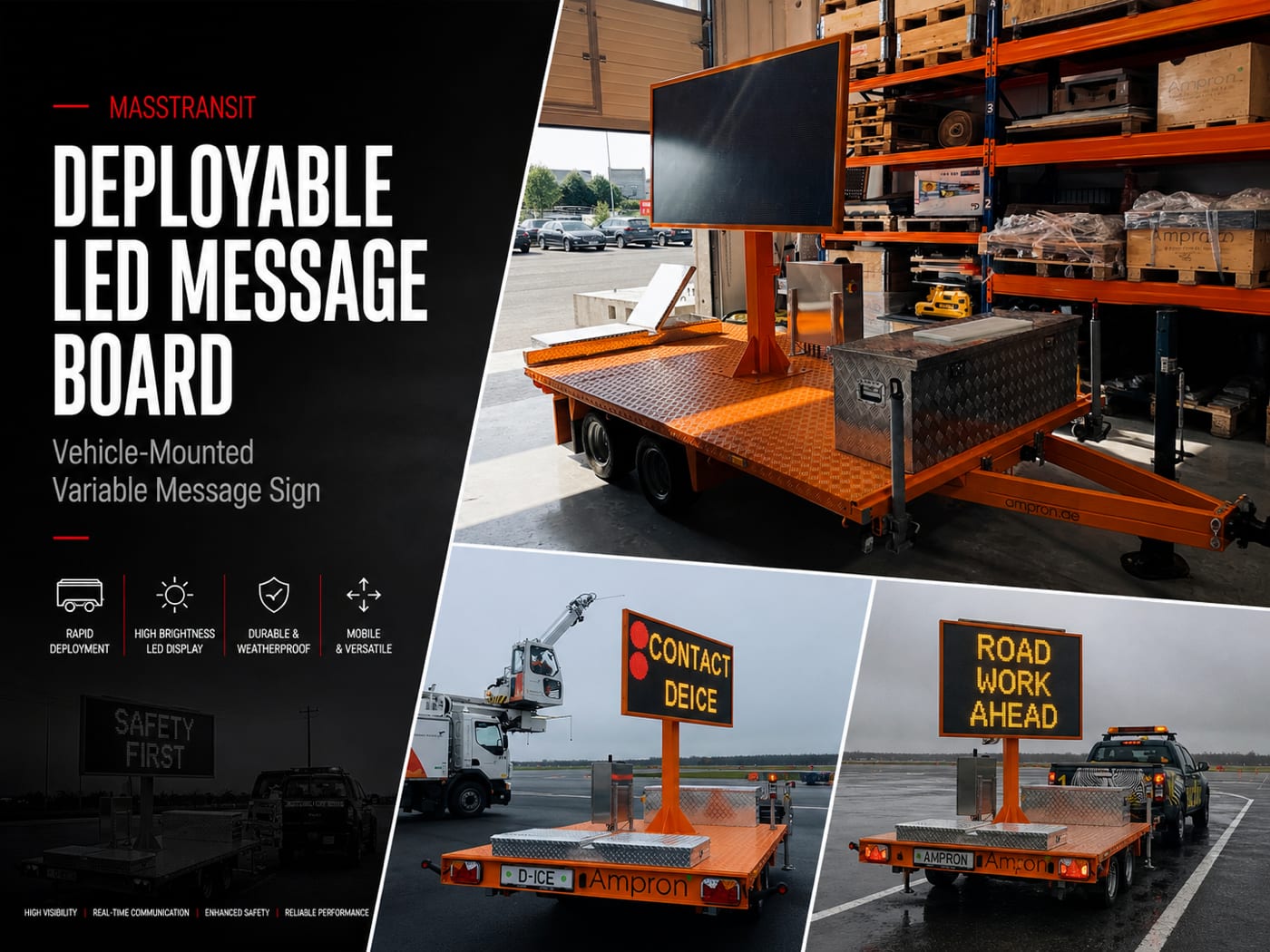
Ampron's vehicle-mounted LED message board solution replaces radio-only communication with a deployable display controlled from the de-icing cab. The operator selects preset messages — radio frequency, pad number, hold or proceed instructions — from a tablet or console interface via REST API. The display shows these instructions clearly to the aircraft crew at operational distance, reducing the confirmation cycle and ensuring both parties are working from the same instruction set. The system is in active use at Tallinn Airport and has been expanded to three simultaneous screens to cover multiple aircraft in sequence during peak winter operations.