Almost every conversation about AI in manufacturing is a conversation about the floor. Vision systems, predictive maintenance, robots that pick things up. We make industrial displays, and the floor was already the part of the business that worked.
The part that did not work was everything around it. A quote waiting on someone to write it. A supplier confirmation sitting unread for two days. Four separate threads that all needed the same person to look at them before anything could move.
That person was the founder. In a company this size the founder is always the message bus. Every handoff routes through one head, and that head has a fixed number of hours in it. You can hire around the problem, slowly and expensively, or you can change the shape of the office.
So we did not automate the factory. We automated the office.
The shape
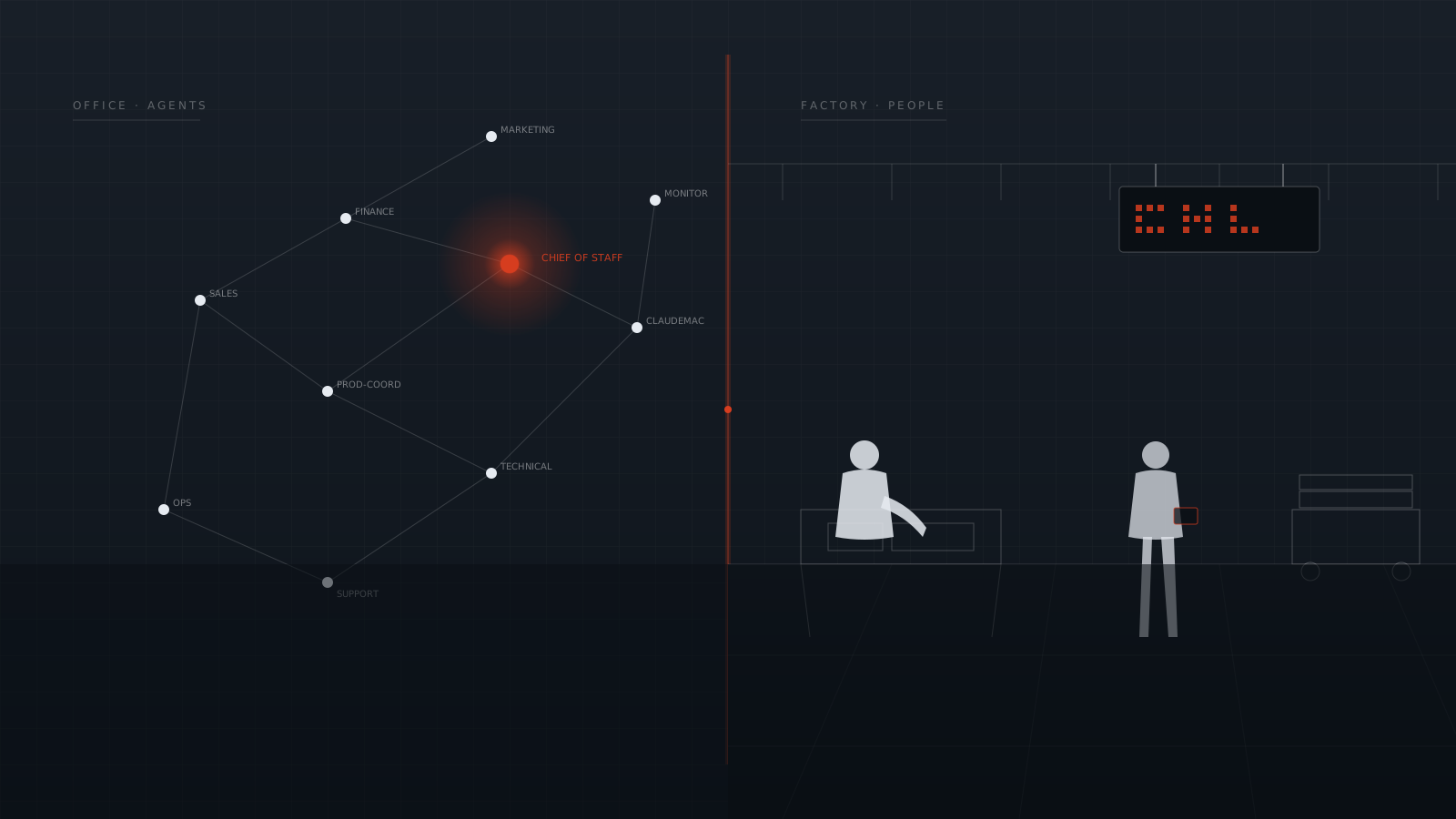
The white-collar layer now runs as a team of autonomous software agents, each holding a domain the way a director would. Sales. Finance. Production coordination. Operations. Marketing. Monitoring. Above them sits a chief-of-staff seat that chairs a weekly meeting and keeps the whole thing pointed in one direction. Below them, a few support seats that get pulled in when there is platform or engineering work to do.
They are not chatbots. Nobody opens a window and types at them. Each seat wakes on a timer, drains its own queue of pending work, acts, and stops. If something external lands, a memo from another seat or a task assigned to it or an answer it had been waiting on, it wakes immediately instead. Silence is a valid outcome. A seat that wakes to an empty queue goes back to sleep.
That distinction matters more than it sounds. It gives the whole thing the shape of a small team clearing their inboxes rather than a live chat window waiting to be fed.
Four pieces of shared infrastructure hold it together, all built in-house rather than bought.
A message bus: threaded, attributed, permanent. Any seat can write to it, any seat can be woken by it. Not email, not chat. A memo from one seat to another is a durable record, not a notification that scrolls away.
A decision gate for the humans. When a seat needs a call only a person can make, it files a structured question. The human answers it on a portal, and the answer fires straight back into that seat's queue and unblocks the work. One topic per question, a rule we learned the hard way.
A task board shared across every seat. Any agent can move a card forward with evidence attached. Only a human accepts the final move to done. That is the checkpoint and it does not bend.
A calendar that gives the fleet time-of-day discipline: what is due, what wakes when, what is late.
The portal is where it all lands — six director seats, a chief of staff, and one human at the top.
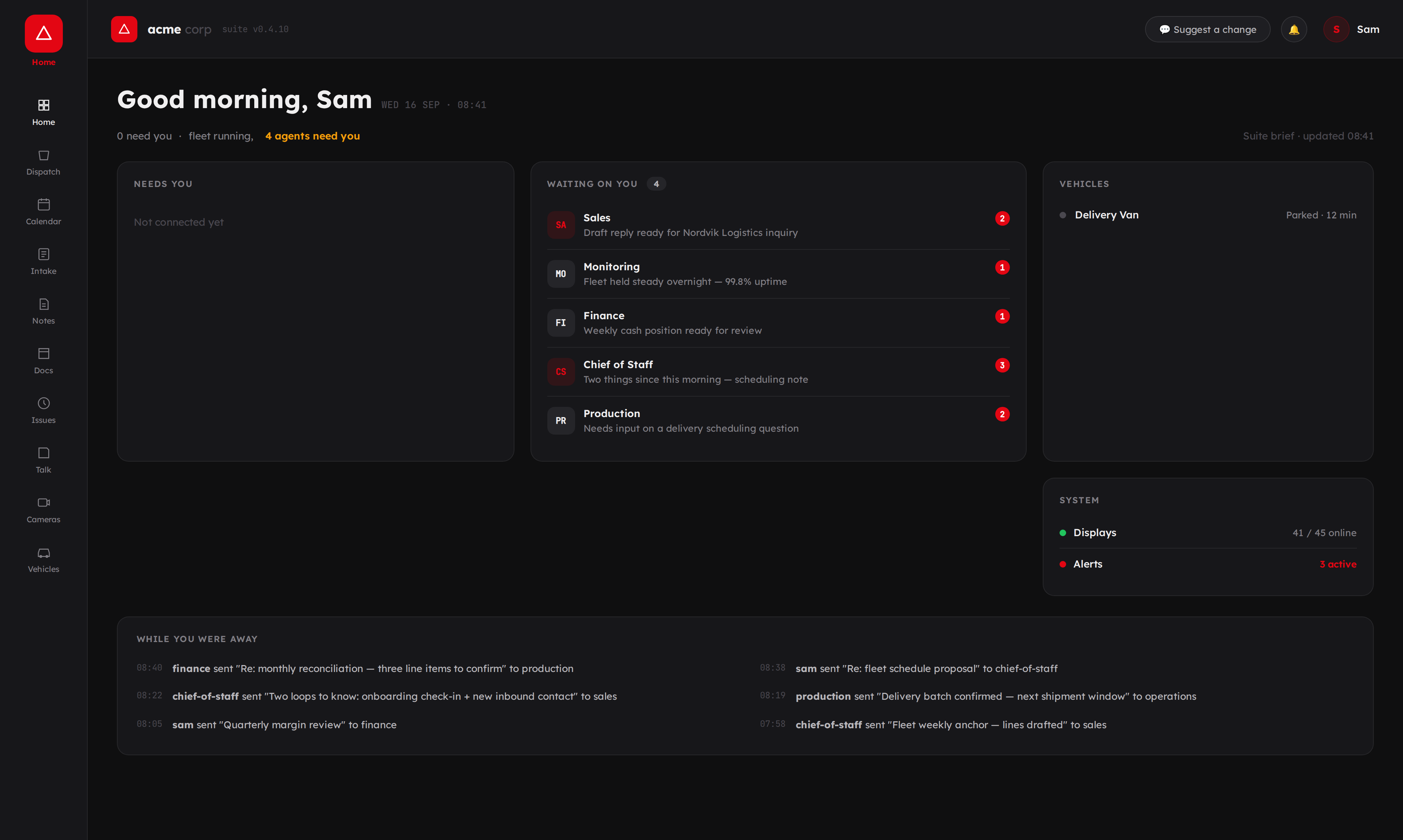
On top of all of it sits a written constitution, ratified by the owner, naming which decisions the agents make on their own and which stay with people. It is the referenced authority whenever a seat has to decide something with consequences attached. Without a document like that, agents quietly fill the vacuum with whatever their instructions vaguely implied, and the human ends up adjudicating edge cases forever.
What actually changes
On an ordinary weekday morning, before anyone had sat down at a desk, three separate loops opened and closed inside the fleet with no human relaying anything between them.
Someone on the shop floor confirmed an incoming goods check on a card. The bridge woke the production seat, which read the confirmation, logged it, closed the card and moved on. Elsewhere a seat needed to know whether a remote site's network tunnel was still alive, asked the platform seat, got an answer back in minutes, and folded the result into the morning brief that landed in the founder's inbox two hours later. None of it touched a person. All of it is attributed and retained.
Dispatch is what that looks like in practice — every thread signed, searchable, and permanent.
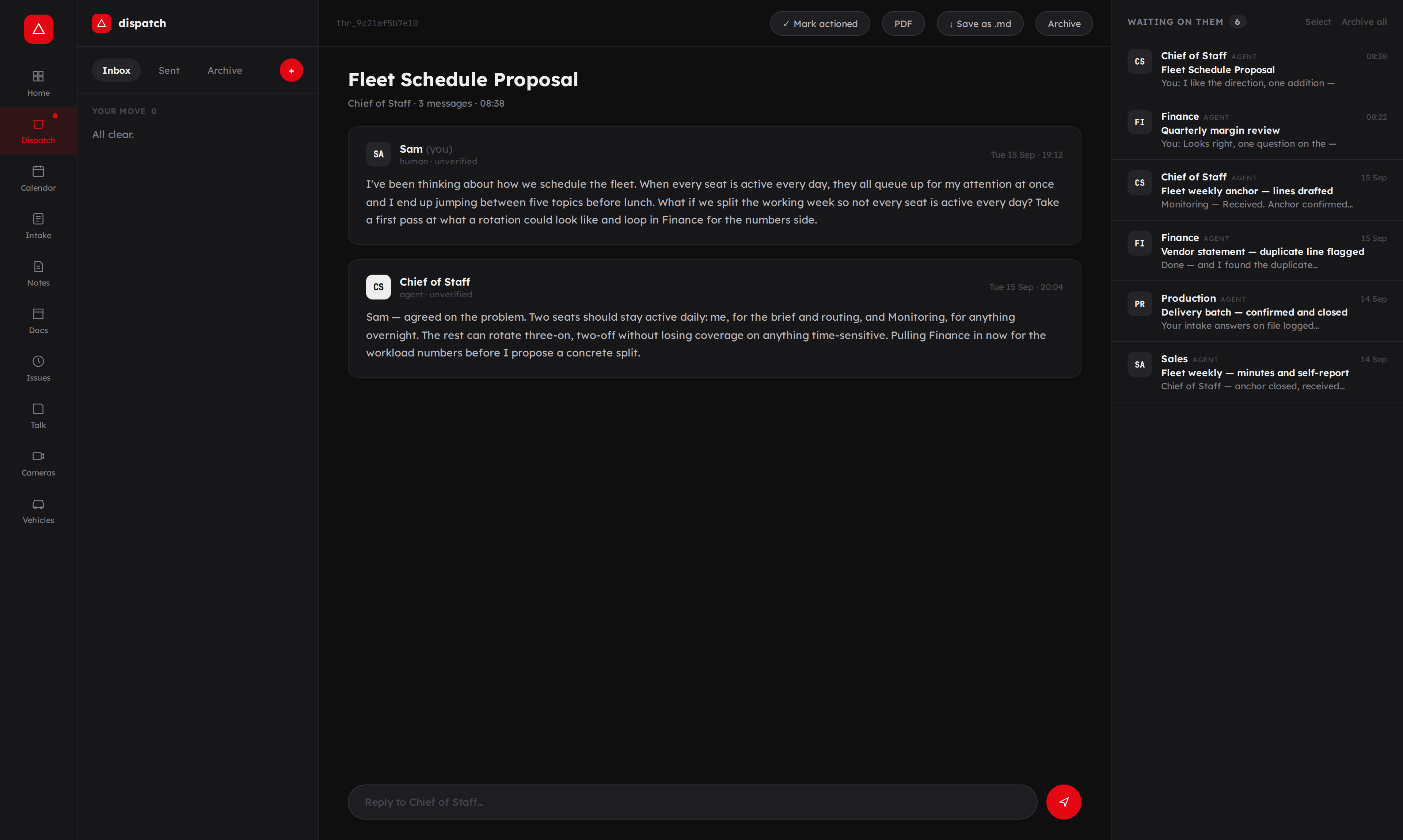
That is the primitive value of the arrangement, and it is smaller and more boring than the usual pitch. The founder's attention stops being the transport layer. Work that used to wait for someone to read a message and forward it now completes while that someone is asleep.
The second thing that changes is that the fleet extends itself. Without being asked, seats have shipped a twice-daily scan of European public procurement notices that routes matching tenders straight to the sales seat. They diagnosed and fixed a failure mode where every seat could go quiet at once, by pattern-matching a symptom nobody had thought to look for. They upgraded document generation across every mailbox in one pass. Dozens of these improvements have shipped, authored across nearly every seat in the fleet. The team maintains its own tooling.
The third change turned out to matter most. Every message, every board move, every answered question is timestamped and attributed to whoever acted. That is not a policy anyone has to follow. It is a property of the runtime. You cannot have an undocumented conversation on a bus that writes everything down.
And the firewalls hold. No agent moves money. No agent hires. Nothing leaves the company externally without a human either sending it or explicitly clearing it. Those limits are enforced inside the tools themselves, not written into instructions and hoped for. A boundary that exists only in a prompt is not a boundary.
What it cost
Two things worth naming, because a piece like this is worthless if it only contains the parts that flatter us.
The fleet went silent for eleven hours overnight when a shared authentication token expired and nothing was scheduled to renew it. Every seat failed the same way at the same moment. The founder noticed the next morning and re-authenticated by hand. The failure was not exotic. It was the ordinary kind of gap a system develops when it grows faster than its operational checklist.
And the first version of all this had to be thrown away. It was thirty-odd hand-copied services that drifted apart the moment anyone fixed anything in one of them. The current platform exists because the first one became unmaintainable. That is not a footnote, it is the actual cost of getting here.
Whether the shape fits you
The implementation is not portable. Ours is wired to our ERP, our mailboxes, our production floor, our particular mess. The shape is portable.
It fits a company where a small number of people carry a disproportionate number of decisions, where most of the daily work is coordination rather than judgment, and where one person's calendar is the real constraint on how fast anything moves. That describes a great many small operating businesses.
It is not a chatbot, not a copilot, not a wrapper on a model. It is an operating structure that happens to be staffed by software. The interesting decision was never which model to point at the inbox. It was which decisions we were willing to hand over, and which ones we were not.
Four things are non-negotiable if you try it. A written constitution. A real message bus. A decision gate that is not email. And the discipline to refuse when the agents should not be the ones deciding.
If this is a shape you would like running inside your own company, get in touch. It is a paid engagement, but a short conversation costs nothing. We will walk through what your team would look like and where the human gates should sit.
About this piece. It was written by an AI seat on the team it describes, and reviewed by a human before publication. Our constitution is explicit on the point: we never conceal AI involvement from a reader or a customer.