Railway infrastructure is one of the most demanding electromagnetic environments for display equipment. Traction power systems, overhead line equipment, signalling circuits, and rolling stock all generate substantial electromagnetic interference. Any electronic equipment installed in a railway environment — including passenger information displays on platforms, departure boards in station halls, and trackside signage — must demonstrate that it neither emits interference that could disrupt railway systems nor is susceptible to interference levels the railway environment produces.
The standard that governs this in Europe is EN 50121. Understanding what it requires — and what it does not — is the first step in specifying compliant display hardware for a railway project.
What EN 50121 covers
EN 50121 is a family of standards, not a single document. The parts relevant to display equipment are EN 50121-4 (emission and immunity requirements for railway signal and telecommunications apparatus) and EN 50121-3-2 (apparatus). The standard specifies both emission limits — the interference a device is allowed to radiate — and immunity requirements — the interference levels a device must withstand without malfunction.
The immunity requirements are the more demanding side for display equipment. Platform environments experience significant magnetic field interference from traction return currents, electrostatic discharge from low-humidity conditions, and voltage surges from switching operations in trackside power supplies. Equipment that passes commercial EMC testing (the CE marking standard) is not necessarily immune to railway-grade interference levels. EN 50121 immunity levels are considerably more stringent.
How certification works in practice
EN 50121 certification requires testing at an accredited laboratory under conditions that simulate the railway electromagnetic environment. For a display product to carry the EN 50121 mark, the manufacturer submits the specific hardware configuration to testing — the display unit, its power supply, its communication interfaces — and the assembled system is tested, not components in isolation.
This matters for procurement: an EN 50121-certified display module does not automatically make an assembled installation compliant if the power supply or cable routing has not been tested as part of the configuration. Network architects and rail contractors should request the test report specifying what configuration was tested, not just the certificate.
Where the standard applies
EN 50121 applies to equipment installed in the railway electromagnetic environment. For display hardware, the relevant zones are platform areas within the station structure, covered concourses with direct exposure to the track zone, and trackside installations. Station concourses that are architecturally separated from the platform — sealed by fire doors, behind a ticket barrier — may not be in the railway electromagnetic environment as defined by the standard. This is a design-specific determination, not a blanket rule.
Station operators and infrastructure managers typically have internal standards that define which zones require EN 50121 compliance. When those standards reference the European standard directly, the certification requirement is clear. When they do not, the question of whether a specific installation location requires compliance should be answered by the infrastructure manager before specification, not after procurement.
Ampron's railway display range
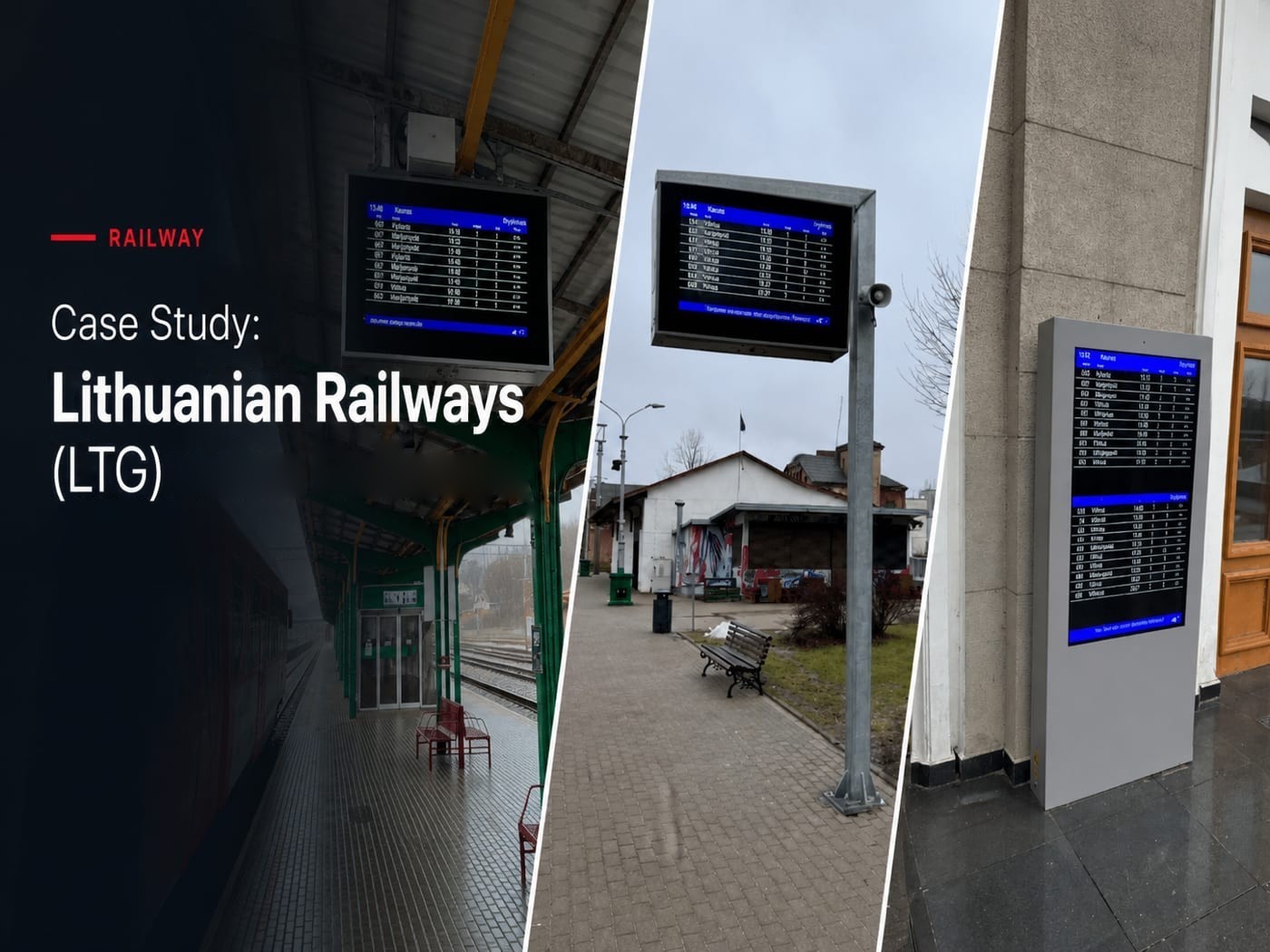
Four of Ampron's railway LCD models are EMC-tested to EN 50121-4 (BST Testing, 2022). Lithuanian Railways and Estonian Railways have both deployed these displays for platform passenger information — departure boards, platform indicators, and multi-zone arrival/departure displays in station halls.
For projects where EN 50121 compliance is a hard requirement, specifying a pre-certified product eliminates the risk of post-installation compliance failure. The alternative — specifying a commercial display and testing the installation after the fact — is more expensive, takes longer, and may require hardware replacement if the test fails.