Port terminals are among the most demanding environments for outdoor display hardware. Salt air accelerates corrosion in sealing compounds and connector contacts. Temperature swings between a warm August afternoon and a January night in the Baltic can exceed 50 °C within a single year. Forklift traffic, vehicles reversing through narrow lanes, and constant mechanical vibration from container handling equipment all load the enclosure in ways that standard outdoor IP ratings do not capture.
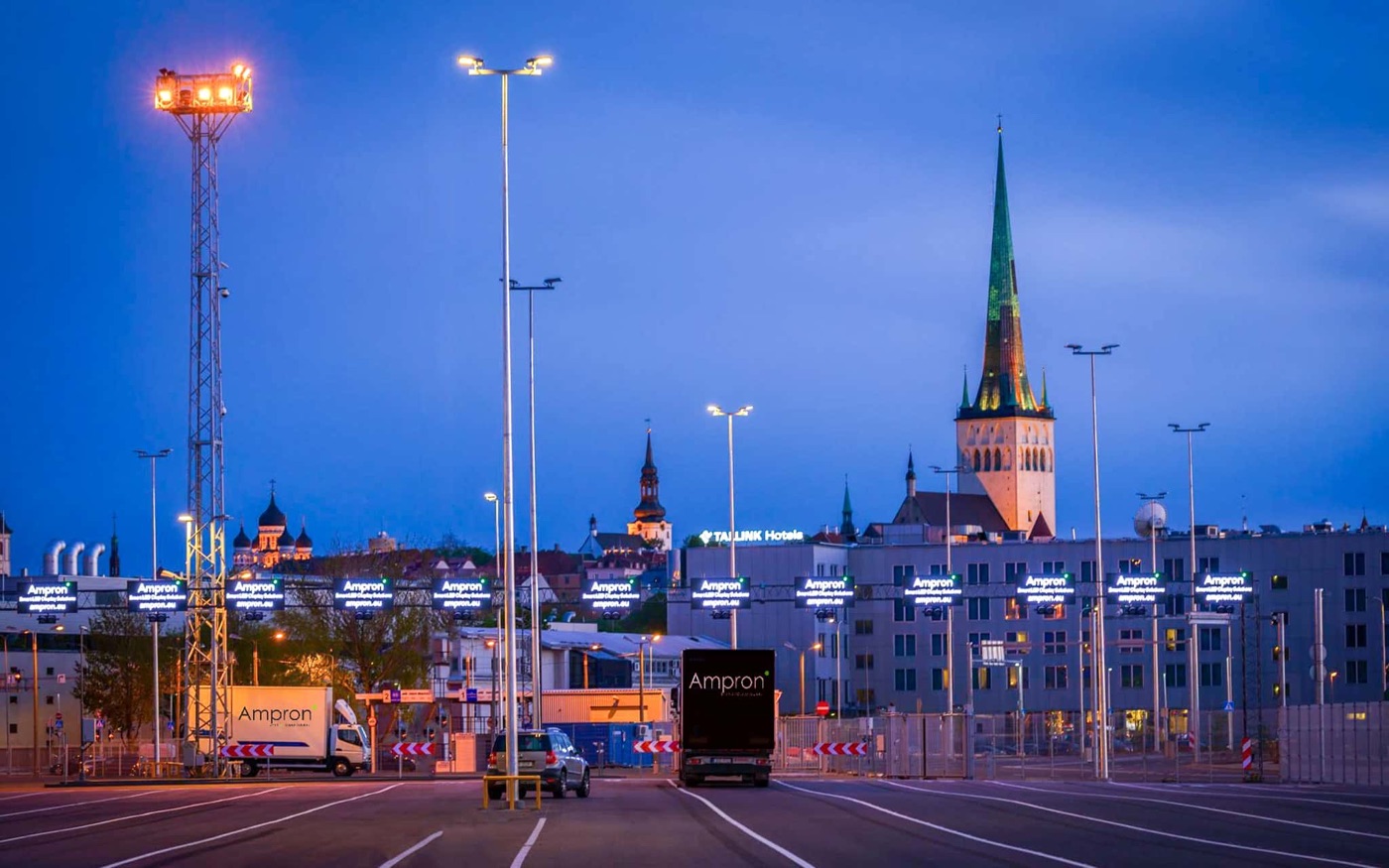
Some 170 LED boards at Port of Tallinn have operated in those conditions since installation. They are distributed across berths, gate lanes, cargo handling areas, and terminal roads — covering the full range of port display applications from berth number identification to truck guidance and lane status.
What port conditions actually require
The IP65 rating covers dust ingress and water jets. In a port environment, the relevant failure modes go further. Salt spray — not rain, but fine airborne salt deposited on surfaces from breaking waves and sea wind — attacks gasket materials and printed circuit boards differently from fresh water. A display that passes IP65 testing in a freshwater chamber may corrode faster in a coastal port than its IP rating suggests.
Temperature range is the other underspecified parameter. Port of Tallinn sits on the Gulf of Finland, where winters regularly reach −20 °C to −25 °C and occasionally touch −35 °C during severe cold snaps. Display electronics rated to −10 °C — the common minimum for commercial outdoor products — will fail or produce errors in those conditions. The DR Series is rated to −35 °C operating temperature, a specification that comes from field experience in Baltic and Nordic deployments rather than from adding margin to a datasheet minimum.
Viewing distance and brightness requirements at port terminals are also higher than typical outdoor applications. A berth display visible from 60–80 metres, in direct sunlight, competing with bright sky as a background, needs sustained output above 5000 cd/m² to remain readable under all daylight conditions. Outdoor advertising brightness levels — around 2500–3000 cd/m² — are insufficient. Automatic brightness control, adjusting output from full brightness in direct sun to a lower level at night, reduces power consumption and extends LED module life without sacrificing readability.
Integration at scale: how some 170 boards are managed
At Port of Tallinn, the display network is driven by the terminal management system via the Ampron REST API. Each display has an IP address on the terminal LAN. Content updates — berth assignments, vessel arrivals, lane status changes, truck guidance — are sent as HTTP POST requests from the TMS. No dedicated display management server sits between them.
At about 170 units across a large terminal, reliable network infrastructure matters as much as the display hardware. Managed switches with VLAN separation, redundant power feeds to display clusters, and network-level monitoring of device availability allow operations staff to identify a display that has gone offline without physically checking the berth. The displays report their status to the monitoring system; the TMS can query availability before sending an update.
The REST API design that makes this work at scale is straightforward: each display accepts a standard HTTP POST to update content, returns a status code confirming the update, and can be polled for its current content and device state. Integrating a new display into an existing deployment means adding its IP address to the TMS configuration and routing updates to it — the same code that drives the first display drives the two-hundred-and-eleventh.
Procurement and specification for port projects
Specifying display hardware for a port terminal project starts with the operating environment, not the display size. Confirm the temperature range including the historical minimum, the distance from the sea (salt spray exposure), the viewing distances and typical ambient light levels for each location, and the network architecture the displays will connect to. From those inputs, the hardware specification follows directly.
Lead times for large-scale outdoor display deployments are longer than typical IT hardware procurement — typically 8–14 weeks from confirmed specification to delivery, depending on quantity and customisation. For projects with fixed commissioning dates, this means starting the specification conversation earlier than feels necessary. Changing a specification after production has started — adding a different enclosure colour, a different character size, a different mounting bracket — delays the project in ways that a longer specification phase would have avoided.
Ampron manufactures DR Series displays in Estonia. That proximity to Northern European port operators is reflected in the operating specifications: the products are designed for the environments they are actually used in, not adapted from products originally developed for warmer or less demanding conditions.